Industry Knowledge
Why Hardness Gradient Engineering Is the Core of a Reliable Self-Drilling Screw
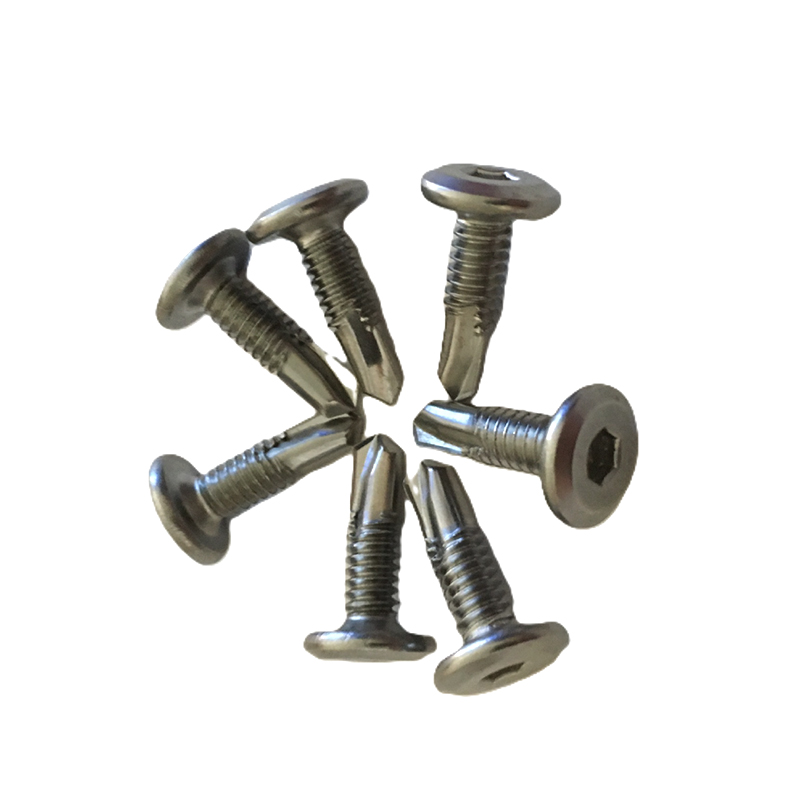
Most engineers evaluate self-drilling screws by point geometry or coating — but the factor that most directly determines whether a screw drills cleanly through steel without fracturing is its hardness profile. A well-engineered drill-tail screw does not have uniform hardness from tip to head. Instead, it is built on a deliberate gradient: the drill tip surface reaches HRC 40–50 to resist abrasive wear during penetration, while the core hardness is maintained at HRC 28–40 to preserve toughness and prevent brittle fracture under the torsional stress of driving. This dual-zone hardness is achieved through selective case hardening — typically carbonitriding or induction hardening applied to the drill point after the thread is rolled — a sequence that preserves thread root ductility while maximizing tip cutting performance.
When this gradient is absent or inconsistent — as is common with low-cost unverified material — two failure modes emerge: tip collapse mid-drilling, where the softened point deforms before completing penetration, and thread slip after engagement, where an overly brittle shank fractures before reaching rated clamp load. Both failures are silent during installation but create long-term structural risk in load-bearing applications like steel structure factories and photovoltaic bracket assemblies. Specifying screws with documented hardness test reports, not just grade markings, is the only reliable safeguard.
Material Selection Beyond Corrosion Resistance: 1022A, 410, and 304/316 Compared in Practice
The three mainstream materials for Self-Drilling Screws each occupy a distinct performance niche that goes well beyond simple corrosion rating. Understanding their mechanical behavior under installation conditions is as important as understanding their environmental suitability.
| Material |
Tensile Strength Range |
Hardenability |
Corrosion Resistance |
Typical Application |
| 1022A Carbon Steel |
800–1,000 MPa (Grade 8.8) |
Excellent — responds well to case hardening |
Depends on surface treatment |
Steel structure factories, color steel tiles, indoor/semi-outdoor with coating |
| 410 Stainless Steel |
700–900 MPa (hardened) |
Good — martensitic, heat-treatable |
Moderate — suitable for low-to-medium chloride environments |
Guardrails, aluminum alloy fastening, general outdoor use |
| 304 Stainless Steel |
520–720 MPa (A2-70) |
Limited — austenitic, cannot be heat-treated |
High — suitable for humid and mildly corrosive environments |
Photovoltaic brackets, cladding panels, general outdoor structures |
| 316 Stainless Steel |
520–720 MPa (A2-70 equiv.) |
Limited — same as 304 |
Very high — Mo addition resists chloride pitting |
Coastal environments, chemical exposure, marine-grade structures |
Material comparison for self-drilling screws by mechanical and environmental performance criteria.
One practical implication often missed in procurement: because 304 and 316 stainless cannot be conventionally heat-treated to achieve drill-tip hardness, manufacturers of high-performance stainless Self-Drilling Screws use bimetal construction — a 410 or carbon steel drill tip friction-welded or mechanically assembled onto an austenitic stainless body. This allows the tip to reach the HRC 40–50 required for penetrating steel substrates while the shank retains the corrosion resistance of 304 or 316. Verifying whether a stainless self-drilling screw is solid-grade or bimetal is essential when specifying for structural applications, as the load capacity and failure mode differ substantially. Shanghai Soverchannel Industrial Co., Ltd. documents this distinction explicitly in its product specifications to prevent misapplication on site.
Drill Point Class Selection for Multi-Layer and Heavy-Gauge Steel Assemblies
Drill point class — commonly designated DP1 through DP5 — defines the maximum combined steel thickness a self-drilling screw can penetrate without pre-drilling. Mismatching point class to substrate thickness is a leading cause of installation failure in steel structure and color steel tile projects, yet it is routinely overlooked in procurement specifications that focus only on diameter and length.
- DP1 (up to 0.8mm steel) — Standard for single-skin color steel tiles and thin aluminum alloy cladding. The shortest drill flute length means fast engagement, but any substrate thickness variation beyond the rated range will cause tip loading and fracture before thread engagement begins.
- DP3 (up to 4.5mm steel) — The most commonly specified class for general steel structure purlin-to-rafter connections and photovoltaic bracket rail attachments. The extended flute allows chip evacuation through thicker material, preventing the binding that causes screw breakage at the drill-thread transition zone.
- DP5 (up to 12mm steel) — Required for heavy structural steel connections, thick guardrail posts, and multi-layer sandwich panel assemblies. The longer drill geometry requires higher rotational speed and consistent axial pressure — pneumatic tools are preferred over cordless battery drivers for DP5 in production environments to maintain consistent penetration torque.
A second dimension often omitted from point class discussion is chip groove geometry. Wider groove angles improve chip evacuation in ductile steels like mild carbon steel, while tighter grooves are better suited for harder stainless substrates where chip volume is lower but cutting resistance is higher. For projects combining dissimilar substrate layers — for instance, an aluminum alloy top rail over a galvanized steel sub-frame — the drill point must be optimized for the harder layer regardless of which it encounters first, since the softer material provides no cutting resistance data for tool selection.
Torque Management and Installation Quality Control for High-Volume Fastening Projects
In large-scale projects such as industrial steel structure factories or utility-scale photovoltaic installations where tens of thousands of Self-Drilling Screws are installed, installation torque consistency directly determines structural integrity — yet torque management is rarely addressed in project specifications beyond a simple "do not overtighten" note. Three torque-related failure modes account for the majority of field callbacks in color steel tile roofing and curtain wall installations:
- Under-torque — Thread engagement is insufficient to develop rated clamping force. The screw may appear seated but will loosen progressively under thermal cycling and wind load, particularly in long-span roof panels where differential thermal expansion creates cyclic shear at each fastener point.
- Over-torque (washer compression failure) — EPDM bonded washers used in weatherproof applications have a finite compression range, typically 0.3–0.8mm of useful deflection. Exceeding this range extrudes the rubber seal beyond the washer edge, destroying the weatherproof function while giving no visual indication at the screw head level during inspection.
- Over-torque (thread strip-out) — In thin sheet substrates, once the thread strips, the screw spins freely without developing clamping force. This is irreversible and requires either upsizing to a larger diameter screw at a new location or installing a backing plate — both costly remediation steps on an occupied structure.
The practical mitigation is specifying torque-limiting screwdrivers or depth-stop attachments rather than relying on operator judgment. For 1022A carbon steel screws at Grade 4.8 in 1.5mm substrate, the installation torque window is approximately 3–6 Nm — narrow enough that an uncalibrated tool will routinely exceed the upper limit. As a manufacturer with extensive quality control experience built through years in the automotive fastener supply chain, Shanghai Soverchannel Industrial Co., Ltd. provides torque specification data sheets with each product series, enabling project engineers to set tool parameters before mobilization rather than diagnosing failures after panel installation is complete. For more details about self-drilling screws, please contact Shanghai Soverchannel Industrial Co., Ltd.